0
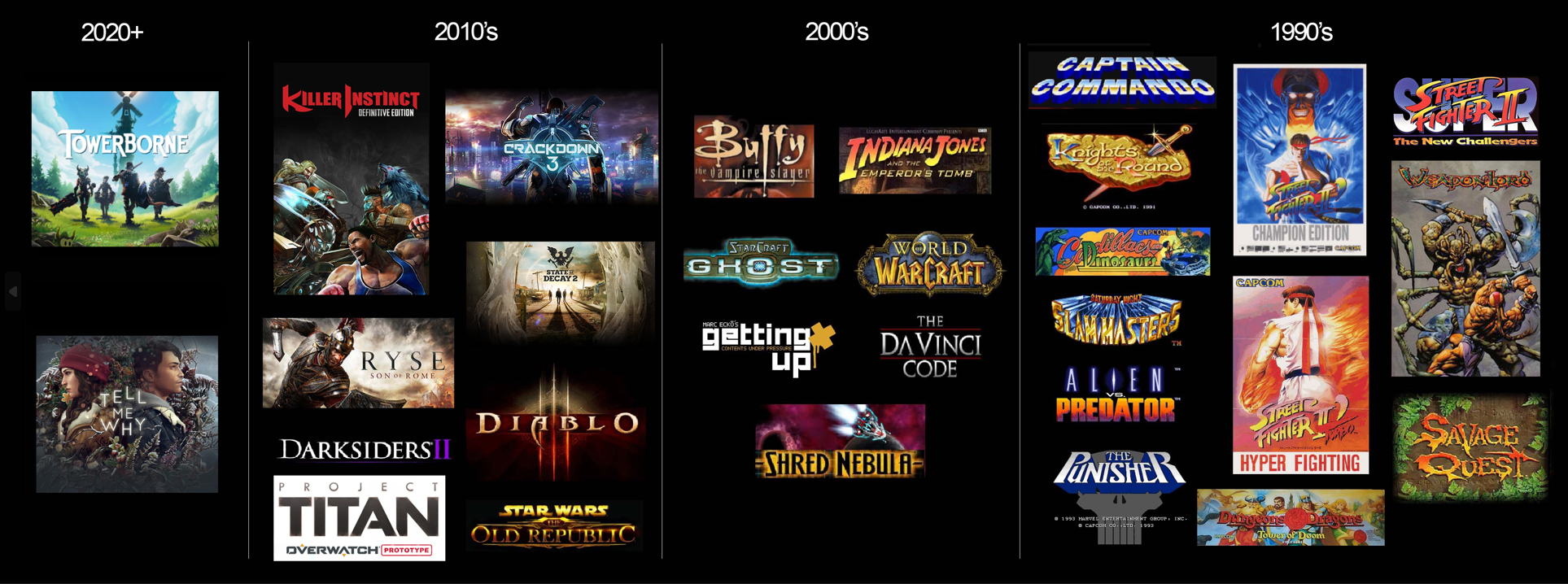
Welcome to my game design reference site. My name is James Goddard and I have been a game designer since 1991 and have been fortunate enough to work on many fun and challenging games. My goal with this site is to openly share the "Visual Game Design" techniques and other system design tricks I have learned over the years and hopefully help students and other aspiring developers with this information. Let me know what you find helpful and feel free to post asking questions I can perhaps help provide reference for. -James Goddard, October 7, 2008.


Navigation
  • Biography
  • CrunchTime Games


  • Tuesday, October 7, 2008

    Shred Nebula Design Document Reference!

    Through my company CrunchTime Games, I have released several design documents from Shred Nebula XBLA.


    I have used these documents at UAT (where I also teach Game Design) as templates for practice pitch and visual game design exercises. Please check them out here: http://www.shrednebula.com/design.html

    These showcase some solid "action thumbnails" (storyboards) key to presenting ideas in a clear, simple manner, a cornerstone of my Visual Game Design approach. The students seem to really find them helpful - let me know what you think.

    Enjoy!

    -DJAMES

    Saturday, December 29, 2007

    FIGHTING SYSTEM PLANNING 101- PART 1

    Metrock1 from the Shoryuken.com community asked me questions that inspired me to share some basic stuff (all I have time to write now).

    Metrock1 is considering learning to program to do a fighting project, he asked about programming languages used in the past and present. Here is my response, which contains some planning prep exercises I do on every project (even if I know already what is needed):

    Programming for fighting is a tough thing, but if you have the mind for it, a fighting game is a good way to 'push' yourself forward as it has some of the most complex concepts possible in the area of input, collision, animation playback - with input & collision precision required tools, sound, etc.

    Current games in 3D are mostly C++ with some assembly code where needed.

    For learning, I recommend straight C++ and direct x (or something else that does a lot already for you). I know people have done some cool things with M.U.G.E.N, there might be enough resources and support in that movement to allow someone to hack it into what they need.

    The big thing most people underestimate is what is needed to do the actual control/character fighting moves & collision & reaction management. The best way to map out what you will need (just at the basic level- your core gameplay engine requirements) is to ask yourself a series of questions on what a few moves will need & walk through (on paper) how you would implement them.

    Example (in order from start to finish):

    Q: What systems are involved in making a simple standing jab work in a 2D fighter?

    A1: Be in a 'ready' standing state -> State awareness (manager)

    A2: Input for button with instant response -> Input at 60fps polling ->A2Q extended: What about coming out of a reaction and pressing a few frames early? A: Need to have some buffering for this to be more friendly -> Polling system with backcheck buffering and command list sort going back x seconds. Note: Critical for 'get up' special attacks!

    A3: Animation, about 6 to 8 frames ->Animation system with ability to play few frames recycled over longer time, also at 60fps (even though animation is traditionally at 30fps)

    A4: Collision to other character with reaction -> collision system with ability to flag what the reaction should be. A4Q extended: How do draw and place these and where is the best place to manage the collision reactions, is it done with bit flag? etc. A: Need a tool to do the collision assignment/sizing and reaction assignment by name or general level -> Sprite import system, Collision box drawing/export to sprite reference system, collision manager database system, etc.

    A5: Character needs to be locked into this move until it is done -> Committed move flag , flag system integrated with State system (for easy management of when things can/cannot be done)

    A6: If hits, the character needs to be able to combo to another move -> combo system (insert your favorite stuff here, chain, 2-in-1, whiff chain, etc) with x requirements.

    ETC.

    That is just a jab, the thing that is the hardest to make feel & look right in 2D or 3D fighting or action fighting games. I also skipped about 10+ other things like:

    • Push back
    • Block reaction time for victim vs hit reaction
    • Hit sparks
    • Collision types needed on jabbing arm (Attack, Defense)
    • Input windows for the combos
    • FX on the jab (motion blur, dust from feet)
    • etc
    END RESPONSE (edited for this blog).

    That is just the beginning, there is obviously a TON of stuff that needs to be planned and the questions really help you NOT UNDERESTIMATE what is really involved. If a Jab can be this complex, what do you think a "flying, deflecting, fireball eating super spinning piledriver" would involve??

    -DJAMES


    Archives

    December 2007   October 2008  


    Copyright 2007 James Goddard | CrunchTime Games Inc.